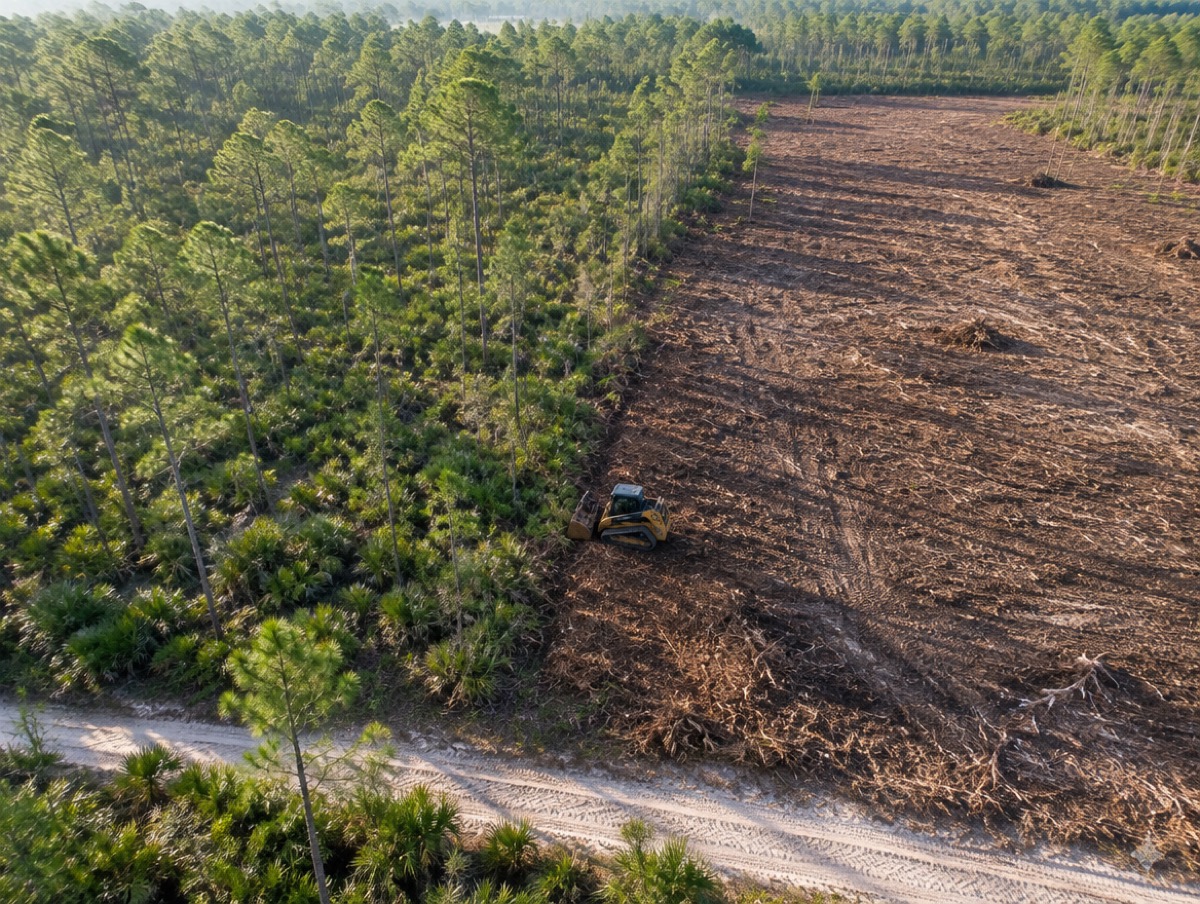
Decide what the land is for
"Clear it" means something different on five acres than on a city lot. A homesite with a yard might need one acre taken down to sand and the rest thinned. A horse property wants open ground with shade trees left standing. Land headed for sale may only need the underbrush cut so buyers can walk it. Each of those is a different machine plan and a different price.
Sketch it on an aerial photo before anyone quotes. Mark the house, the drive, the trees and wet spots you know about, and where you'd like to leave woods as a buffer from the road or the neighbors.
Surveys the county may want
In unincorporated Brevard, parcels larger than 1.25 acres that carry existing canopy or trees more than 10 inches in diameter need a tree and vegetation survey for the county's Natural Resources Management office. Wetland boundaries need a certified survey delineated within the last five years, and any wetland impact needs a mitigation plan. Land on the Indian River Lagoon, the St. Johns River or Lake Washington also needs a surface water protection buffer survey (Brevard Natural Resources, permitting tips).
That office will also do a desktop review of a property for wetlands, flood-prone ground and protected wildlife. On acreage, that review is worth having before a machine is booked.
North county has its own version. Titusville won't issue a clearing and grubbing permit without a tree survey, and the survey has to come from a Florida registered land surveyor, an FNGLA-certified horticulture professional or a landscape architect licensed in Florida (Titusville LDR s. 30-40).
One acre changes the stormwater rules
Florida's construction stormwater permit covers work that disturbs 1 acre or more, or less when it's part of a larger common plan, and drains to surface waters or a storm sewer system. It calls for a stormwater pollution prevention plan and a notice of intent filed at least two calendar days before work starts (FDEP construction generic permit). Ask who is preparing those before you sign anything.
Brevard's land clearing permit also expects erosion and sediment controls that follow the state's inspectors manual (Brevard County Code s. 62-4338). On a big sandy tract, that can mean a long run of silt fence along the low side.
Wildlife on bigger ground
More ground means more chances of a gopher tortoise burrow. If clearing has to come within 25 feet of one, FWC requires a permit (FWC). Under FWC's permitting guidelines, the application needs a burrow survey of at least 15% of the potential habitat. The authorized agent then completes a 100% survey no more than 90 days and no fewer than 72 hours, weekends and holidays excluded, before tortoises are captured and moved. If clearing doesn't start within 90 days of the latest 100% survey or capture, the site has to be surveyed again (FWC permitting guidelines).
Look up, too. FWC recommends checking its Historical Bald Eagle Nesting Areas map before land clearing and keeping a 660-foot buffer from nests. The map isn't complete and doesn't replace an on-the-ground look (FWC bald eagle FAQs).
Penalties count by the quarter acre
The county treats each quarter acre, or fraction of one, cleared in violation as a separate violation, and each protected tree removed as another. No permits or certificates of occupancy are issued until it's resolved, and the director can issue a stop-work order on the spot (Brevard County Code s. 62-4336). On ten acres, a shortcut adds up fast.
Questions for the crew
Big jobs go sideways on access and sequence more than on the clearing itself. Ask:
- Which machines are coming, and how do they handle soft sand and wet spots?
- Is the price per acre or one number for the tract? The cost guide covers what moves it.
- Where does the material go: mulched in place, piled in rows, or hauled?
- How will flagged wetlands, buffers and burrows be marked and avoided?
- Who prepares the stormwater paperwork if more than an acre is disturbed?
- What order does the work go in, and where do trucks get in and out?
Questions people ask
How much does it cost to clear an acre in Brevard?
It depends on how thick the growth is, how many trees and stumps there are, what happens to the material and how wet the ground is. The land clearing cost guide collects published estimates with their sources. The crew you're matched with prices your land after walking it.
Can land with standing water or wetlands be cleared?
Not without the right permits. Filling wetlands or building in them may need an Environmental Resource Permit from the St. Johns River Water Management District or FDEP (SJRWMD), and the county wants wetland lines surveyed and impacts mitigated. Clearing the uplands around a wet area is a different, simpler job. Flag the wet edge first.
Is agricultural land exempt from clearing permits?
Brevard's code exempts bona fide agriculture from its land clearing rules (Brevard County Code s. 62-4334), and Palm Bay's code has a similar exception. Whether your use qualifies is a question for the county or city, and state wildlife and wetland rules still apply. See pasture reclamation.
How long does acreage clearing take?
Machine time depends on density and ground conditions, and the crew can estimate it after a walk. Paperwork often takes longer. FWC asks for paper gopher tortoise permit applications 90 days ahead and says most are processed in 45 days or less (FWC permitting guidelines).
Can I clear the homesite now and the rest later?
Phasing works and spreads out the cost. Clear the house, drive and work area first, then thin or mulch the rest when you're ready. Mind the clocks: a county permit for a single-family lot expires 90 days after it's issued (s. 62-4338), and a tortoise survey goes stale if clearing doesn't start within 90 days of it.
Last reviewed October 7, 2026. General information, not legal or professional advice. Check the linked sources for the current rules.
Sources
- Brevard County Natural Resources, permitting review process
- Titusville LDR, Chapter 30 tree classes and surveys (s. 30-31 and s. 30-40)
- FDEP, NPDES construction generic permit
- Brevard County Code s. 62-4338, land clearing permit standards
- FWC, Gopher tortoise permits
- FWC, Gopher Tortoise Permitting Guidelines (PDF)
- FWC, Bald eagle frequently asked questions
- Brevard County Code s. 62-4336, penalties
- St. Johns River Water Management District, do you need a permit?
- Brevard County Code s. 62-4334, exemptions