Last reviewed October 7, 2026. General information, not legal or professional advice. Check the linked sources for the current rules.
What the law protects
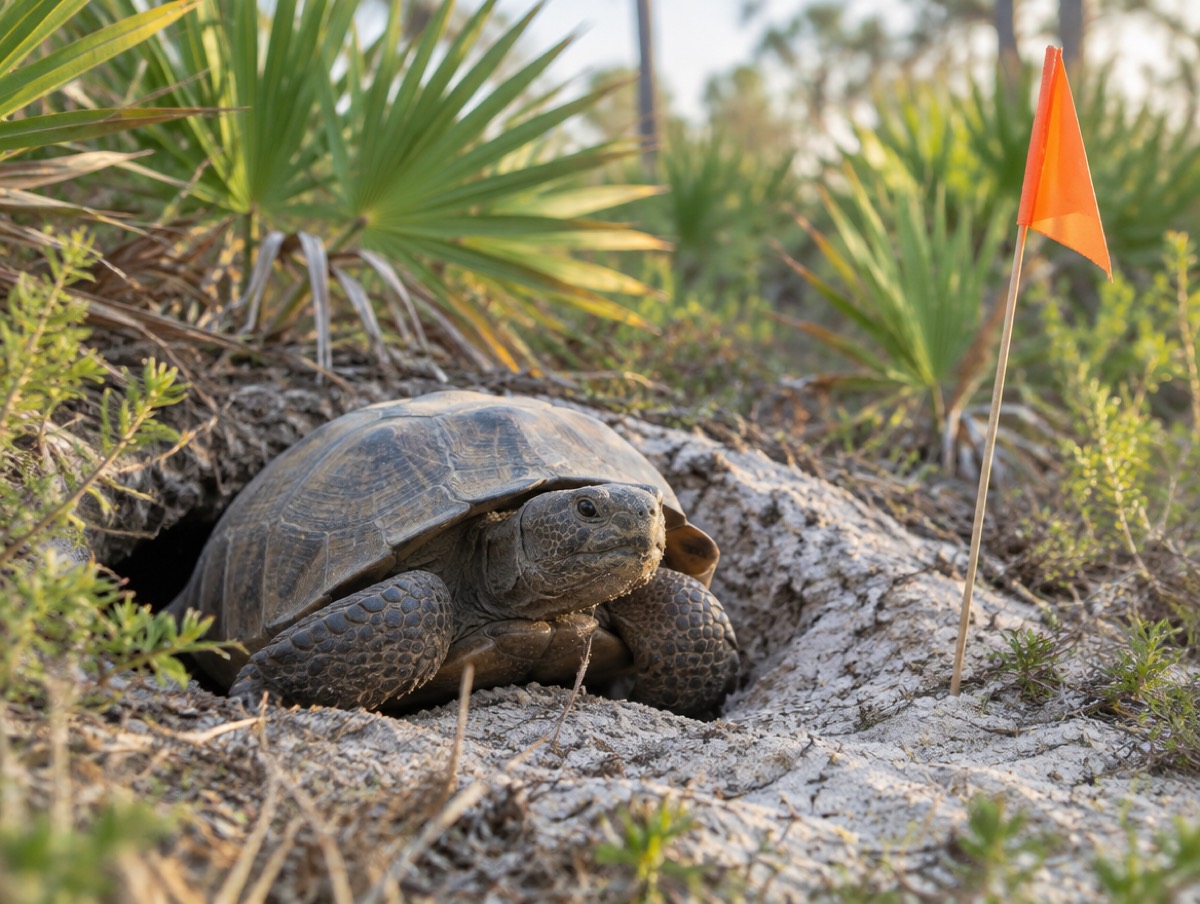
The gopher tortoise is a state-designated threatened species. Under Rule 68A-27.003, nobody may take, harass, capture, possess or move a tortoise, or damage or destroy its burrow, without an FWC permit (FWC gopher tortoise rules).
The burrow is protected along with the animal. That's the part that matters on a clearing job, because a mulching head or a dozer blade doesn't have to touch the tortoise to break the rule.
The 25-foot rule
Before any clearing, grading, bulldozing, digging or site preparation within 25 feet of a burrow that may be occupied, FWC requires a relocation permit. Work that stays 25 feet or more from every burrow and tortoise needs no permit (FWC gopher tortoise permits).
Do the geometry before you count on the buffer. A 25-foot circle around one burrow covers close to 2,000 square feet. On a 10,000-square-foot house lot that's about a fifth of the ground, and if the burrow sits where the house or driveway goes, there's no staying 25 feet away.
On acreage the buffer is easier to live with. A fence line, a trail or a thinned understory can often be routed around flagged burrows, as long as every machine and every pile stays outside the line.
Surveys and the 90-day clock
FWC's permitting guidelines, revised in April 2023 and part of Rule 68A-27.003, set the timing (FWC Gopher Tortoise Permitting Guidelines):
- A permit application needs a burrow survey covering at least 15 percent of the potential habitat.
- The authorized agent completes a 100 percent survey, with a burrow map delivered to FWC, no more than 90 days and no fewer than 72 hours before capture and relocation, not counting weekends and holidays.
- If clearing doesn't start within 90 days of the most recent 100 percent survey or capture, the site has to be surveyed again before clearing.
- Paper applications should go in 90 days ahead. FWC says most are processed in 45 days or less.
The 10 or Fewer Burrows permit
For sites with 10 or fewer burrows, FWC has a simpler permit. Landowners who can't keep 25-foot buffers can get it by completing an FWC e-learning course or by hiring an Authorized Gopher Tortoise Agent. The 100 percent survey runs in transects no more than 33 feet apart, over the development area plus 25 feet around it (FWC, 10 or Fewer Burrows).
Moving tortoises off the site takes an Authorized Gopher Tortoise Agent and a recipient site, and both charge fees. FWC's mitigation contribution is the same whether the tortoises are relocated on site or off (FWC). Sites with more burrows go through the other permit types described in the permitting guidelines.
Who does what
An FWC Authorized Gopher Tortoise Agent does the surveys and the relocation, and FWC keeps a locator map of agents on its permits page (FWC). The clearing crew does not survey or move tortoises, and this site doesn't arrange that work either.
What the crew you're matched with can do is plan the clearing around flagged burrows, or start once the agent's work is done and the permit allows it. A clearing price covers clearing. If burrows turn up after you've agreed on a price, talk about the schedule before anyone unloads a machine.
Why clearing first is the expensive order
Clearing first and calling FWC later gets the sequence backward. The survey has to happen while the burrows can still be found and mapped, and a scraped lot leaves nothing to survey but a problem.
Cities notice too. Palm Bay's tree code says impacts to protected species found during a violation get reported to the regulating agencies (Palm Bay Code ch. 175). Melbourne bars altering vegetation in designated occupied gopher tortoise habitat without federal approval (Melbourne LDC s. 9.272). And Palm Bay's own habitat plan for scrub-jays doesn't cover tortoises. Those permits come from FWC (City of Palm Bay).
A schedule that works
For a lot you plan to build on, this order keeps things moving:
- Walk the lot and look for burrows before you sign a clearing contract. Take photos and note where they sit relative to the house and driveway.
- If any burrow is within 25 feet of the planned work, contact an Authorized Gopher Tortoise Agent from FWC's locator map.
- Apply for the FWC permit early, leaving time for review.
- The agent completes the 100 percent survey and any relocation.
- Clearing starts inside the 90-day window, after the Sunshine 811 notice for any digging (Sunshine 811).
Questions people ask
Can I just keep the machines 25 feet away?
Yes. As long as all the work stays 25 feet or more from burrows and tortoises, FWC doesn't require a permit (FWC). Flag the burrows so the operator can see them from the seat.
Can I move the tortoise myself?
Not without an FWC permit. On a site with 10 or fewer burrows, a landowner can qualify for the permit by completing FWC's e-learning course, but off-site relocation still takes an Authorized Gopher Tortoise Agent (FWC).
What if the burrow looks abandoned?
FWC's rule is written around potentially occupied burrows, so don't make that call by eye. The survey is what FWC goes by.
How much time does this add?
FWC asks for paper applications 90 days ahead and says most are processed in 45 days or less (FWC). Add the survey timing on top, and set the clearing date around it.
Sources
- FWC, Gopher tortoise rules and regulations
- FWC, Gopher tortoise permits
- FWC, Gopher Tortoise Permitting Guidelines (rev. April 2023)
- FWC, 10 or Fewer Burrows permit
- Palm Bay Code of Ordinances, Chapter 175 (tree protection, land clearing and grubbing)
- Melbourne LDC s. 9.272, tree removal permits
- City of Palm Bay, Habitat Conservation Plan
- Sunshine 811, frequently asked questions