About this service
Who actually does the clearing?
An independent local contractor that works where your land is. We take the request, find a crew that covers that area and pass it on. The crew walks the lot, prices it and books the work with you, and your agreement is with them.
What does it cost to use this service?
Nothing. Sending a request and getting matched is free. You pay the contractor only for work you agree to, and if the price doesn't work you owe nothing.
What parts of Brevard County do you cover?
The whole county. You can send a request from Mims and Titusville down to Palm Bay, Grant-Valkaria and Micco, and we look for a crew that works the area your land is in. The service areas page lists the local rules by city.
Permits and local rules
Do I need a permit to clear my lot in Palm Bay?
For most house lots, yes. Under Palm Bay Code s. 175.014, you need a permit to clear any land on a residential lot smaller than 1 acre or to cut a tree whose diameter at breast height is 6 inches or more. You'll need a site sketch marking each tree's size and species, the recorded deed and a signed hold-harmless agreement. Review takes 7 days. The Palm Bay build-lot guide walks through it.
What about Merritt Island and the rest of unincorporated Brevard?
Unless the property is exempt, the county wants a permit in hand before land clearing starts (s. 62-4337). Its code counts removing or cutting down vegetation, trees included, and root-raking as land clearing. Allowable mowing, trimming and pruning are left out (s. 62-4332). A clearing permit for a single-family lot expires 90 days after it's issued and has to be posted where it can be seen from the road (s. 62-4338).
Is there a smaller permit for light clearing in the county?
Yes, in unincorporated Brevard. It's called the small scale land clearing permit, an administrative waiver covering as much as 10% of the native canopy and 50% of the understory or 1 acre, whichever is less. It can't approve removing specimen trees. It expires 30 days after it's issued, and a property gets one per calendar year (s. 62-4338(5)).
Can I clear my Palm Bay lot before I have a builder?
If the clearing is for a new house, plan on lining up the builder first. When a single- or two-family lot under 1 acre is cleared for development, Palm Bay wants a building permit already under review and its application number on the clearing application (s. 175.014).
Which trees on my lot are protected?
It depends on who governs the parcel. In unincorporated Brevard, measured 4.5 feet above grade, hardwoods of 10 inches or more in diameter on the mainland or Merritt Island are protected, and so are softwoods such as pines at 14 inches or more. On the barrier island both thresholds drop to 1.5 inches, and invasive species don't count (s. 62-4332). Palm Bay's line is 6 inches for any tree (s. 175.014).
What happens if a lot is cleared without a permit?
It gets slow and costly. In unincorporated Brevard each quarter acre cleared in violation is a separate violation, each protected tree removed is another, and no permits or certificates of occupancy are issued until it's resolved (s. 62-4336). In Palm Bay the owner gets a stop-work order or violation notice and 1 week to apply at double the fee. If little evidence is left, the city can require 4 restoration trees per quarter acre (s. 175.014).
Can a lot with wetlands or standing water be cleared?
Sometimes, with more permits. Building in or filling wetlands may need an Environmental Resource Permit from the St. Johns River Water Management District or FDEP (SJRWMD). Brevard asks for a certified wetland boundary survey done within the last 5 years and a mitigation plan for any wetland impact. The county's Natural Resources office can also run a desktop review of a property for wetlands, flood-prone ground and protected wildlife (Brevard Natural Resources).
Does clearing a lot need a stormwater permit?
Bigger jobs do. Florida's construction generic permit covers work that disturbs 1 acre or more, or less if it's part of a larger common plan, and drains to surface waters or a storm sewer system. It needs a stormwater pollution prevention plan and a notice of intent filed at least 2 calendar days before work starts (FDEP).
Wildlife on the lot
I found a tortoise burrow on my lot. Now what?
You plan around it. Gopher tortoises are state-threatened, and no one may capture or move them, or damage their burrows, without an FWC permit (FWC rules). Clearing, grading or digging within 25 feet of a potentially occupied burrow needs a relocation permit. If all work stays at least 25 feet away, no permit is needed (FWC permits). Moving a tortoise is a job for an FWC Authorized Gopher Tortoise Agent. The gopher tortoise guide covers the permit types.
How much time does a tortoise permit add?
Plan on weeks. FWC says paper applications should go in 90 days ahead and most are processed in 45 days or less. If clearing doesn't start within 90 days of the most recent full burrow survey, the site has to be surveyed again (FWC permitting guidelines). Lots with 10 or fewer burrows that can't keep the 25-foot buffer have their own permit, which a landowner can get by finishing an FWC online course or hiring an Authorized Agent (FWC, 10 or Fewer Burrows).
Is my Palm Bay lot scrub-jay habitat?
It might be if it sits on old scrub. Florida scrub-jays are federally threatened and live in sand pine and xeric oak scrub and scrubby flatwoods on ancient sandy ridges (FWC). A U.S. Fish and Wildlife Service notice in the Federal Register covered applications for incidental take permits, with habitat conservation plans, to clear Palm Bay single-family lots (Federal Register, May 11, 2006). Ask the city whether your parcel is flagged before you book anything. The scrub-jay lot guide has more.
Should I check for eagle nests?
It's worth doing before clearing. FWC recommends checking its historical bald eagle nesting map and keeping a 660-foot buffer from nests. Not every nest is on that map, so walk the property and look up as well (FWC bald eagle FAQs).
The work itself
What is forestry mulching, and how is it different from bulldozing?
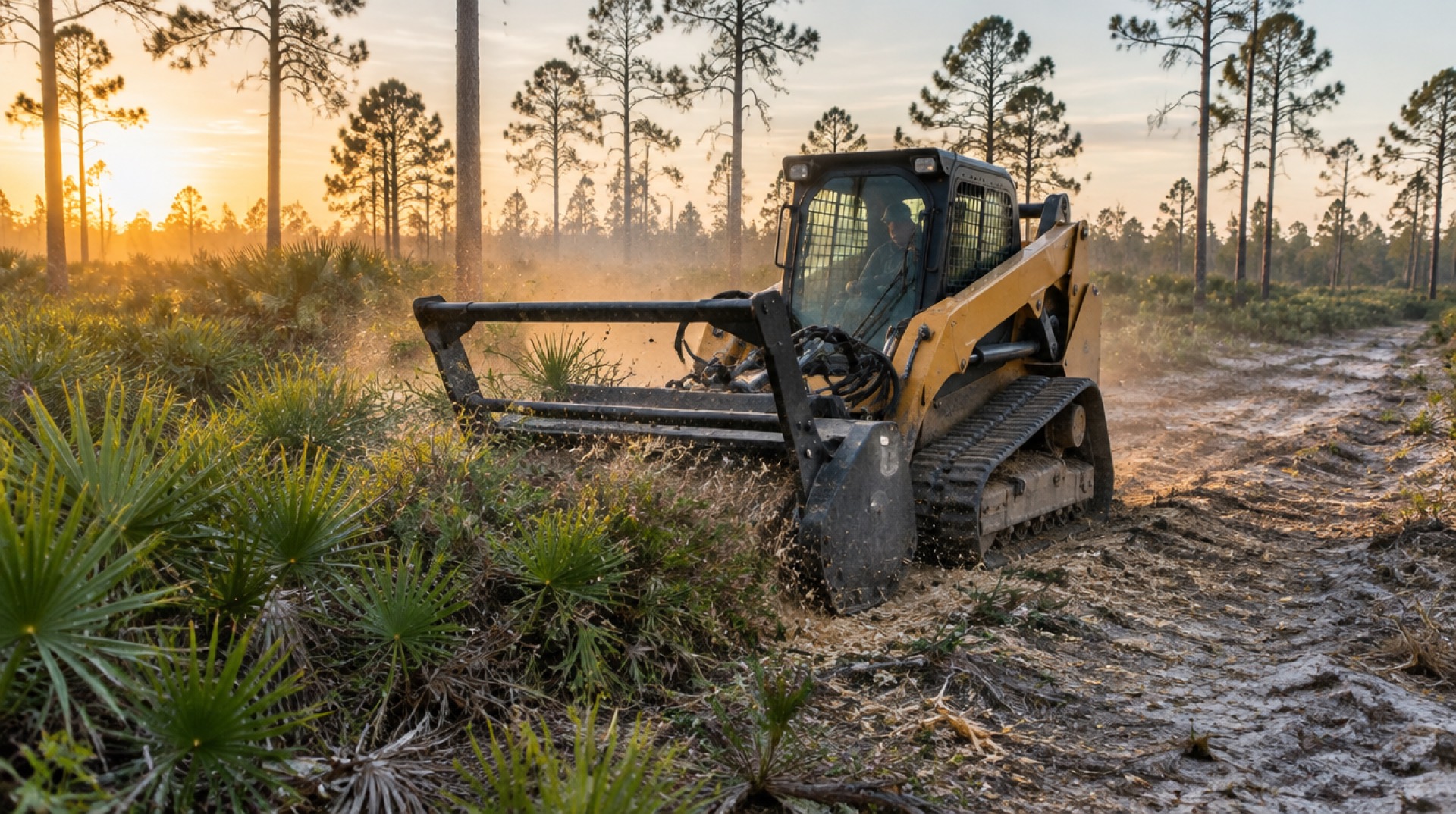
A forestry mulcher grinds palmetto, brush and small trees where they stand and leaves the chips on the ground. A dozer or excavator pushes growth over and pulls roots, and the piles get hauled away. One leaves a mulch layer, the other leaves bare sand. The mulching vs bulldozing guide compares them, and the forestry mulching page covers the job.
Will Brazilian pepper grow back after it's mulched?
Big stands usually do. UF/IFAS says mechanical removal works on small infestations, but large stands resprout vigorously, so herbicide or stump treatment is usually needed (UF/IFAS plant directory). Ask the crew what follow-up their price includes, and ask the same about palmetto. The Brazilian pepper page has more.
Can I burn the brush on my property?
On most house lots, no. Every land clearing pile burn needs a Florida Forest Service authorization, and residential piles must be 300 feet from occupied buildings other than yours, 100 feet from paved public roads and 50 feet from brush (FFS, Know the Law). A quarter-acre lot with neighbors on both sides can't meet those distances. Brevard's automatic drought ban on open burning excludes state-permitted burns, including FFS-authorized pile burns (Brevard County Code s. 50-1), so the setbacks are what decide it.
Do I need to call 811 before stump removal or grading?
Yes. Under Florida law, Sunshine 811 must get two full business days' notice at minimum before any digging, and grading, moving earth and scraping all count as digging (Sunshine 811 FAQs). Ask the crew who is making the request.
Do I have to remove the stumps before building?
Ask your builder. The site plan shows where the house, driveway and septic system go, and the builder decides which stumps have to come out. Have the crew price stump removal as its own line so you can see what it adds.
How long does it take to clear a lot?
The machine work is often the short part. Palm Bay's permit review takes 7 days (s. 175.014), a gopher tortoise permit can add weeks (FWC), and the crew's calendar sets the rest. Once the permit is in hand, ask for the start date in writing.
How much does it cost to clear a lot or an acre?
It depends on the land. Lot size, how thick the growth is, the terrain, stump removal, hauling, permits, grading and surveys all move the price (HomeAdvisor land clearing cost guide). The cost guide has published estimates with their sources. The crew you're matched with gives you the real number after walking the lot.
Does the debris get hauled away or left as mulch?
That's your call, and it changes the price. Mulching leaves chips spread over the ground. Hauling takes everything away and leaves bare sand. If a house is going on the lot, ask your builder which one they want before the crew prices it.
My vacant lot got a code notice. What should I do?
Read what the notice asks for and by when, then send it with your request. Mowing and clearing are different jobs. In unincorporated Brevard, allowable mowing, trimming and pruning are outside the code's definition of land clearing (s. 62-4332). In Palm Bay, land clearing on a residential lot under 1 acre needs a permit (s. 175.014). If the notice only asks for the lot to be cut down, say so, and see overgrown lot cleanup.
What does build-ready mean?
It means different things to different builders, so get it in writing. It can mean stumps out of the house footprint, debris gone, a graded pad and fill brought in. Agree on the list with your builder, then hand that list to the crew. See grading and pad prep.