Last reviewed October 7, 2026. General information, not legal or professional advice. Check the linked sources for the current rules.
What mulching and bulldozing each leave behind
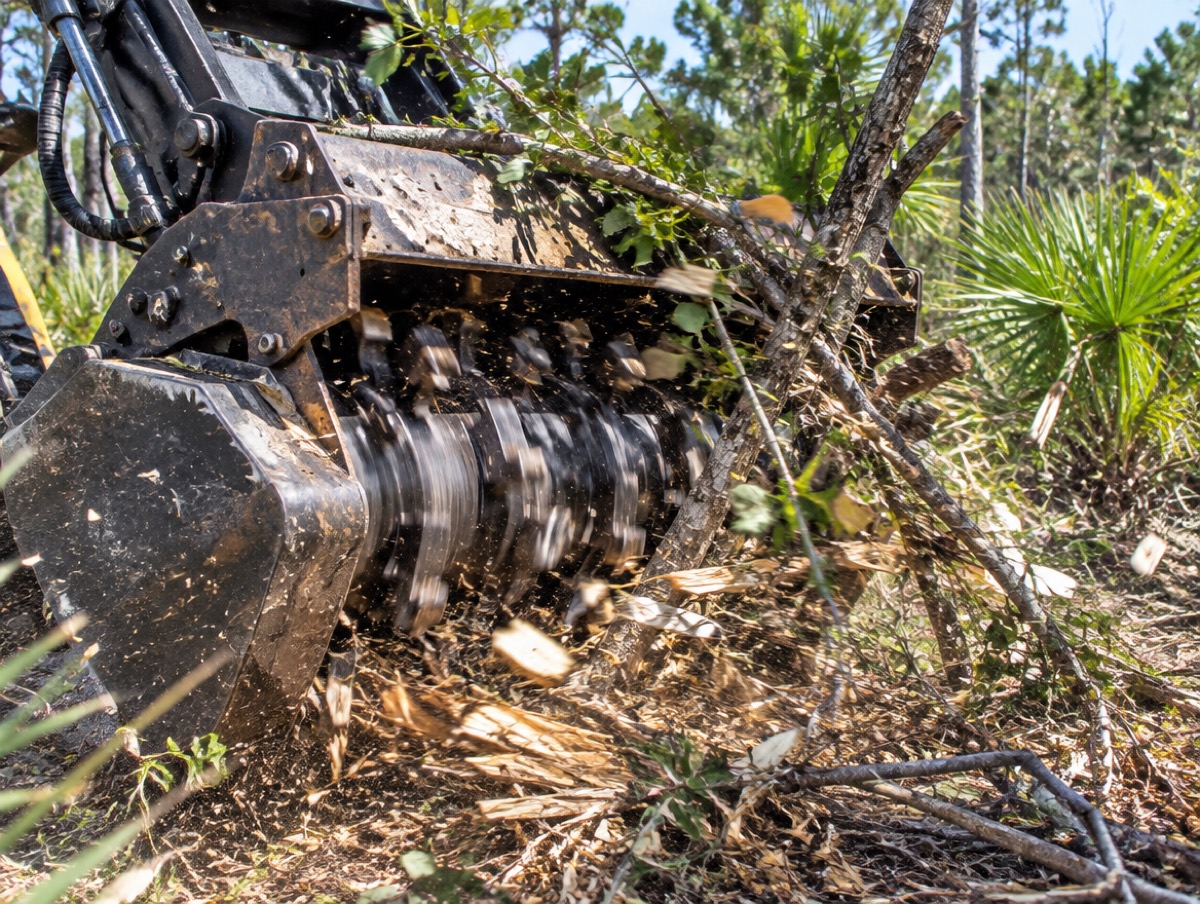
Forestry mulching leaves a layer of chips over the soil, with roots still in the ground and stumps cut low. The sand stays covered and mostly stays put. It's the common way to open up palmetto and brush under pines, cut a fence line or a trail, or thin a back acre without turning it into bare dirt.
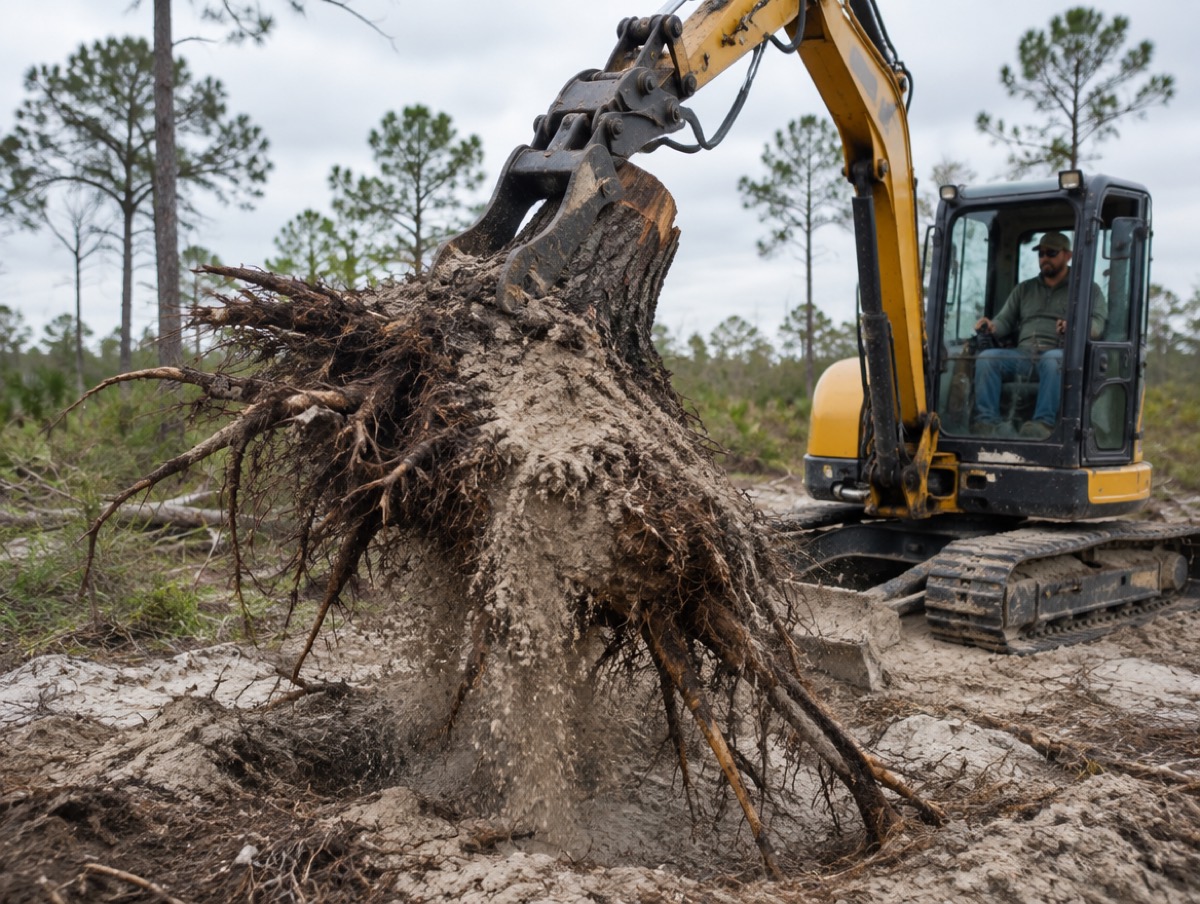
Bulldozing and root-raking strip the site. Stumps and roots come out, the ground ends up bare and loose, and the cut material sits in windrows or piles until it's hauled off, ground or burned. A building pad or a driveway base usually needs ground like that.
The codes draw the same line. Brevard County's definition of land clearing includes root-raking (Brevard County Code s. 62-4332). Palm Bay treats hand clearing, roto-chopping and mulching in place as grubbing, and its grubbing permit doesn't cover clearing, scraping, balancing or filling land (Palm Bay Code s. 175.015).
- Mulching: chips left on site, stumps low, roots in place, little bare soil and nothing to haul.
- Bulldozing or root-raking: stumps and roots out, bare sand, and piles to haul, grind or burn.
- A mix: stumps pulled under the house and driveway, mulch on the rest of the lot.
Building a house? Ask what goes under the slab
A chip layer and a field of old roots are fine on a back acre and wrong under a foundation, because buried organic material rots and settles. Before picking a method for a house lot, ask the builder or engineer what they need cleared out of the footprint, the driveway and the ground around them.
For site-specific permits under its master plan program, Palm Bay's building department asks for a signed and sealed survey showing the flood zone and minimum finished floor elevation, plus a signed and sealed drainage plan for Public Works (Palm Bay Building Department). The grades and the fill follow from those, and whatever sits under the fill has to suit them. In practice that usually means stumps out where the house goes. The fill dirt guide covers the next step.
Can you burn the piles instead?
Legally, sometimes. On a house lot, almost never. Every land clearing pile burn in Florida needs a Florida Forest Service authorization. For residential debris, meaning a home site of no more than two family units, the pile has to sit 300 feet from occupied buildings other than the landowner's, 100 feet from paved public roads and 50 feet from wildlands or brush, and it has to be dry and attended. Non-residential debris needs 1,000 feet from occupied buildings, or 300 feet with a DEP-permitted air curtain incinerator (FFS, Know the Law). The state rule behind it is Rule 5I-2.006, F.A.C.
Three hundred feet is the length of a football field between the goal lines. On a quarter-acre lot with houses on both sides, there's nowhere to put the pile. On 10 or 20 acres out in Grant-Valkaria or Mims the setbacks might work, and that's a conversation between the landowner and the Forest Service before anything is lit.
Brevard's own ordinance automatically bans open burning, such as trash burning, when the county's Keetch-Byram Drought Index average reaches 500, and lifts the ban when it falls below 450. State-permitted burns are excluded from that ordinance, so the Forest Service authorization is the piece that decides a land clearing burn (Brevard County Code s. 50-1).
Brazilian pepper: mulching is step one
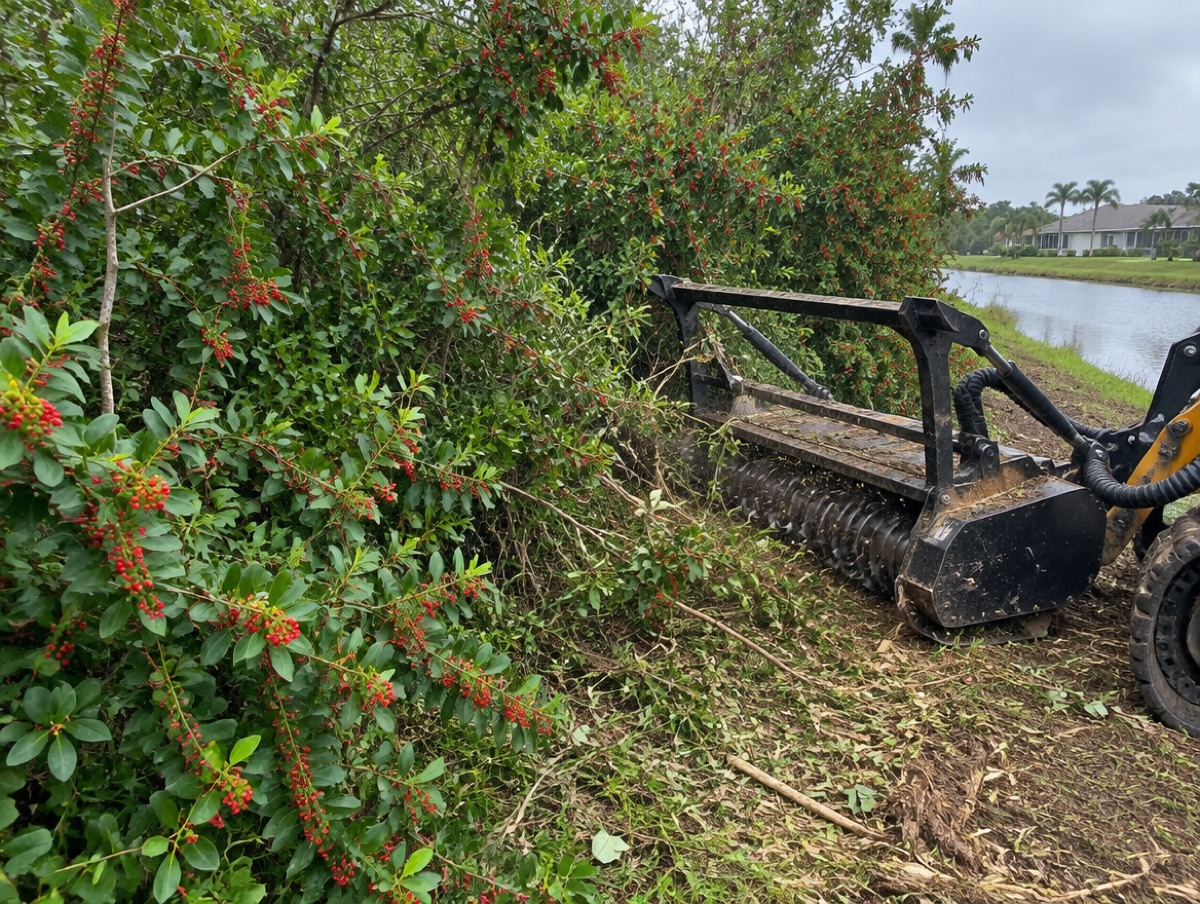
Brazilian peppertree is a FISC Category I invasive and is on Florida's Noxious Weed List. UF/IFAS says mechanical removal works on small infestations, but large stands resprout vigorously, so herbicide or stump treatment is usually needed (UF/IFAS Plant Directory).
So a mulcher can take a pepper thicket by a pond down to chips, and it will come back unless the stumps are treated. Ask whoever quotes the job what the follow-up plan is. The Brazilian pepper page has more.
Keeping trees: either machine can hurt them
If some trees stay, how the machine moves around them matters more than which machine it is. Brevard's code counts soil compaction, trunk and root injury from machinery, stored materials and grade changes over the roots as land clearing (Brevard County Code s. 62-4338). Mark the trees that stay, keep machines and piles off their root zones, and put that in the written price. The selective clearing page goes further.
Mulching or bulldozing: which fits your job
A rough guide, before the crew you're matched with sees the land:
- Palmetto and brush under pines on acreage you're keeping wooded: mulching.
- A quarter-acre house lot: stumps and roots out under the pad and driveway, the rest mulched or hauled, as the builder asks.
- Old pasture grown up in brush: mulching, then regular mowing to keep it open.
- A fence line or a firebreak: a mulcher.
- Brazilian pepper: mulching plus stump or regrowth treatment.
- A pond, a driveway cut or any digging below grade: excavator work, after the Sunshine 811 notice (Sunshine 811).
Questions people ask
Is forestry mulching cheaper than bulldozing?
HomeAdvisor's per-acre mulching figure is for pasture clearing, and it's lower than the site's range for heavily forested land (HomeAdvisor). Mulching also skips the haul-off. It stops being cheaper if the builder needs the stumps out anyway. The cost guide has the published numbers.
Is a permit required to mulch instead of bulldoze?
In unincorporated Brevard, removing or cutting vegetation counts as land clearing, and allowable mowing, trimming and pruning don't (s. 62-4332). In Palm Bay, mulching underbrush in place is grubbing, and single- and two-family sites under 1 acre are exempt from the grubbing permit (s. 175.015). Removing trees is a separate question in both.
Can the brush piles be burned instead of hauled?
Only with a Florida Forest Service authorization and the setbacks, which for residential debris include 300 feet from other people's occupied buildings (FFS). On a lot with neighbors close by, that rules it out.
Sources
- Brevard County Code s. 62-4332, definitions
- Palm Bay Code of Ordinances, Chapter 175 (tree protection, land clearing and grubbing)
- City of Palm Bay Building Department, Master Plan Building Permit Program
- Florida Forest Service, Know the Law (land clearing burns)
- Rule 5I-2.006, F.A.C., open burning
- Brevard County Code s. 50-1, open burning
- UF/IFAS Plant Directory, Brazilian peppertree
- Brevard County Code s. 62-4338, land clearing permit standards
- Sunshine 811, frequently asked questions
- HomeAdvisor, Land Clearing Cost (updated June 17, 2026)