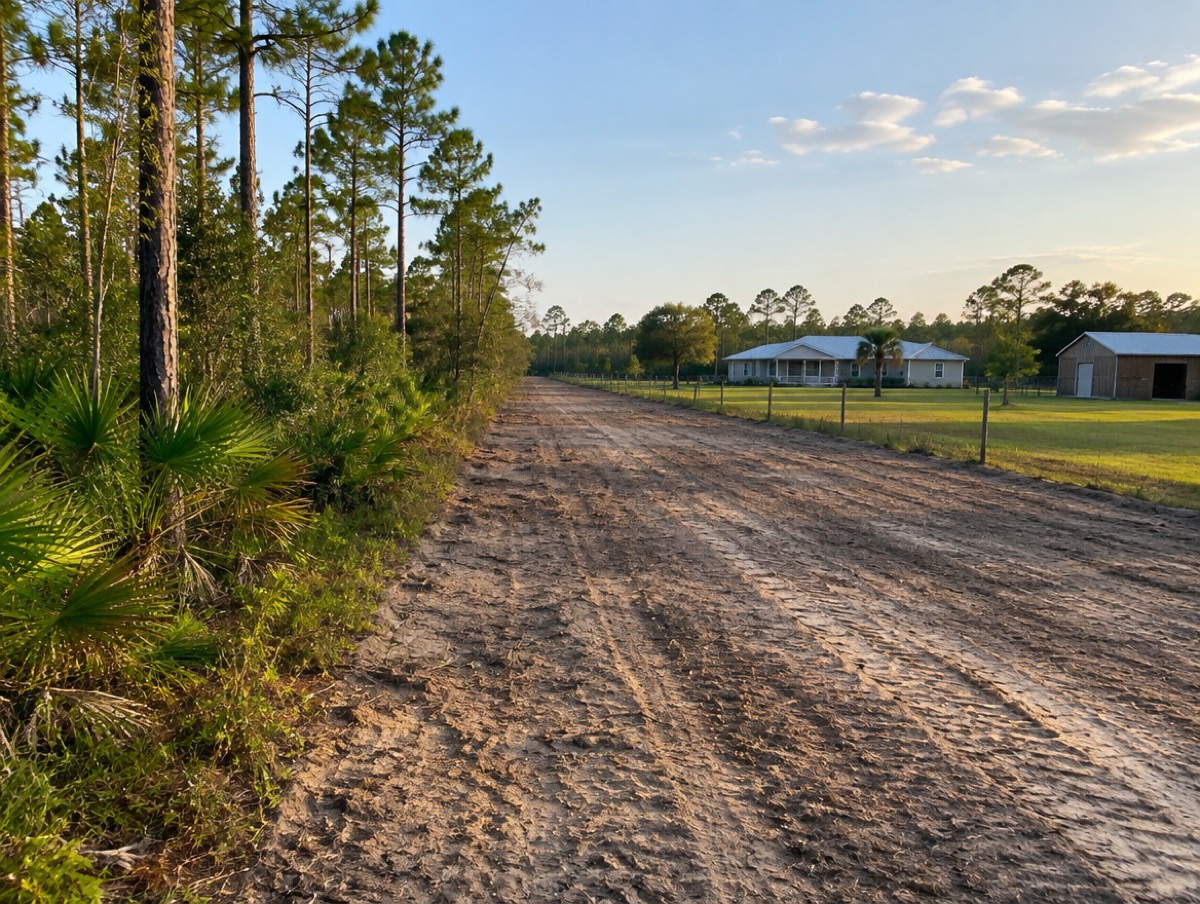
What a firebreak is on private land
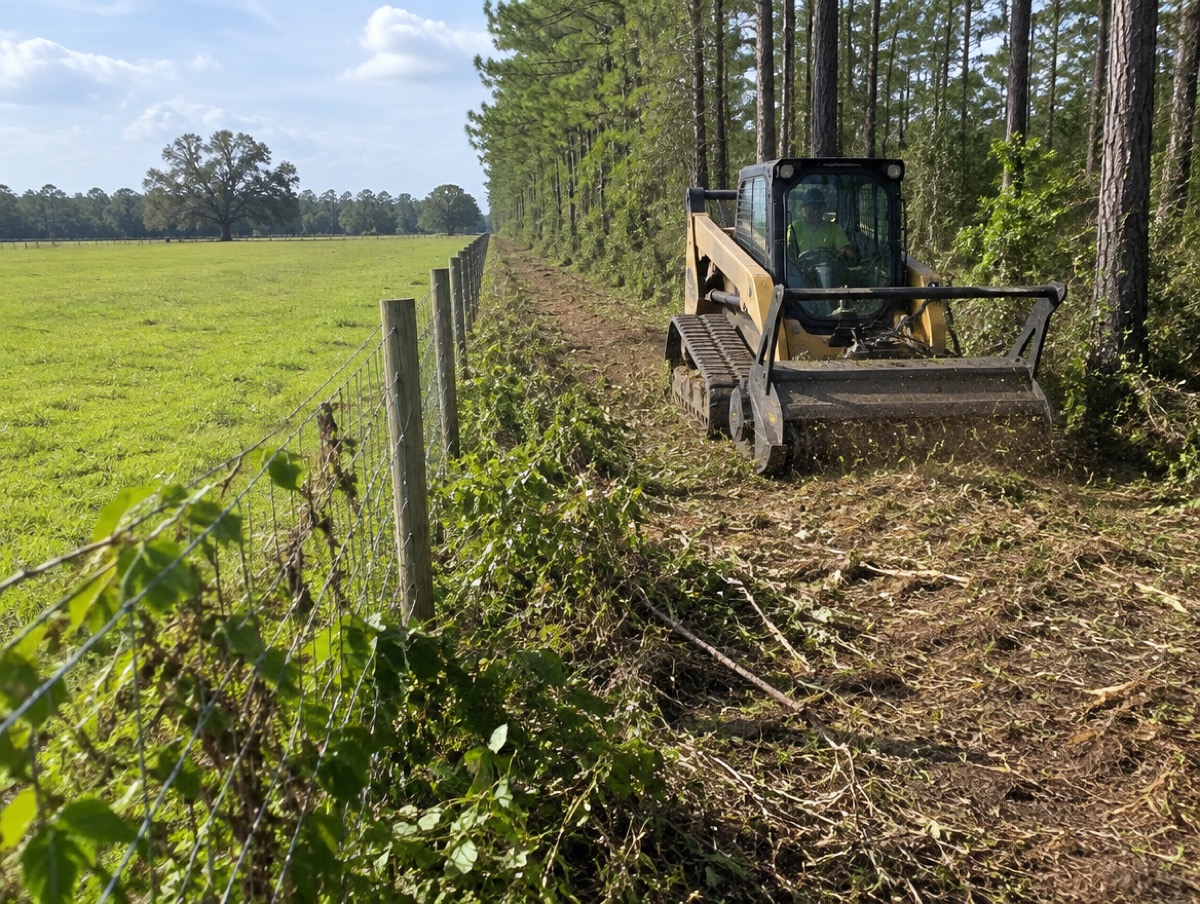
A firebreak is a strip where the fuel has been cut down or taken away. Around a house, that usually means mowing or mulching the palmetto and brush back from the walls and keeping it that way. Along a property line or a woods edge, it can be a mulched lane wide enough for a truck, or a strip disked or scraped down to sand.
Mulched and bare strips trade off. A mulched strip keeps the sandy soil covered and is gentler on the roots of nearby trees. A strip scraped to bare sand takes away more fuel, needs more upkeep and, in the county, may count as land clearing. Some properties use both: bare close to the buildings, mulched along the woods.
Where it falls in the code
Brevard County's definition of land clearing covers removing or cutting down vegetation, trees included, and root-raking, but leaves out allowable mowing, trimming and pruning (s. 62-4332). Land clearing needs a permit unless the property is exempt (s. 62-4337), and bona fide agriculture is among the exemptions (s. 62-4334).
Where a firebreak plan lands on that line is a question for the county before anyone scrapes. For smaller jobs, the county's small scale permit allows removing up to half the understory or 1 acre, whichever is less (s. 62-4338). Inside a city, ask the city.
Why the brush doesn't get burned
Burning cut brush is tightly limited in Florida. Skipping Florida Forest Service authorization for a yard waste burn takes all of this: a pile no wider than 8 feet or a noncombustible container, 25 feet of clearance from your house and from woods or brush, 150 feet from any other occupied building, 50 feet from a paved public road, lighting after 9 a.m., and the fire out an hour before sunset. Bigger piles need FFS authorization (FFS, burn yard waste safely). Land clearing pile burns always do (FFS, Know the Law).
Brevard's own ban on open burning switches on automatically when the county's average Keetch-Byram Drought Index reaches 500. State-permitted burns, including FFS-authorized pile burns, are excluded from the county ban (Brevard County Code s. 50-1), so the Forest Service rules are the ones that matter for brush piles. Plan on mulching or hauling.
Wildlife and the woods next door
Firebreaks sit at the edge of habitat. Keep 25 feet from gopher tortoise burrows unless an FWC permit covers the work (FWC), and check FWC's eagle nest map, which comes with a recommended 660-foot buffer from nests (FWC).
If the woods next door are scrub, low oaks on white sand, they may hold Florida scrub-jays, a federally threatened bird (FWC). Read the scrub-jay guide before cutting into it.
Keeping it open
Palmetto and brush grow back, and a firebreak that has grown over doesn't do much. Ask how often your strip will need another pass and whether the crew offers upkeep visits.
- How wide will the strip be, and mulched or bare?
- Are low limbs over the strip cut back, and is that in the price?
- Where does the cut brush go?
- Are there burrows or nests on the route?
- What does a maintenance pass cost compared with the first cut?
Questions people ask
How wide should a firebreak be?
This site doesn't publish a standard width. The right answer depends on what grows beside it and what has to drive on it. The Florida Forest Service is the agency to ask about wildfire risk on your land; then set a width with the crew and write it into the price.
Can the cut brush be burned?
Only within Florida Forest Service rules, and land clearing piles always need FFS authorization (FFS). During a Brevard burn ban, open burning is prohibited apart from exceptions such as state-permitted burns. Mulching or hauling is the practical route.
Does cutting a firebreak need a permit?
Mowing is treated differently from land clearing in the county code, while scraping or root-raking is land clearing. Ask the county or your city before work that goes down to bare soil. Farms may fall under the agriculture exemption.
How often does a firebreak need maintenance?
As often as the growth needs it. The crew that cuts it can tell you what regrowth to expect on your ground and price return visits.
Is there a burn ban right now?
Brevard's ban turns on automatically when the county's average drought index reaches 500 and lifts when it falls below 450 (s. 50-1). Check the county's announcements or the Florida Forest Service before any burning.
Last reviewed October 7, 2026. General information, not legal or professional advice. Check the linked sources for the current rules.
Sources
- Brevard County Code s. 62-4332, definitions
- Brevard County Code s. 62-4337, permit required
- Brevard County Code s. 62-4334, exemptions
- Brevard County Code s. 62-4338, land clearing permit standards
- Florida Forest Service, burn yard waste safely
- Florida Forest Service, Know the Law (land clearing burns)
- Brevard County Code s. 50-1, open burning
- FWC, Gopher tortoise permits
- FWC, Bald eagle frequently asked questions
- FWC, Florida scrub-jay profile