Last reviewed October 7, 2026. General information, not legal or professional advice. Check the linked sources for the current rules.
The two elevations that decide it
The first is existing grade. For a floodplain permit, Palm Bay asks for a signed and sealed survey with NAVD88 elevations at the four corners of the lot, the center, any sharp changes in grade and the crown of the road in front of the proposed house (Palm Bay floodplain permit requirements). That shows how flat or tilted the lot really is.
The second is the target. For site-specific permits under its master plan program, Palm Bay's building department asks for a signed and sealed survey showing the FEMA flood zone, base flood elevation and minimum finished floor elevation, plus a signed and sealed drainage plan reviewed by Public Works (Palm Bay Building Department). In a flood zone, the final lowest adjacent grade has to sit above the base flood elevation (Palm Bay). The county and the other cities set their own requirements, so ask the building department that will issue your permit.
To see the flood zone before any of that, look the address up on FEMA's Flood Map Service Center (FEMA Flood Map Service Center).
Turn it into cubic yards
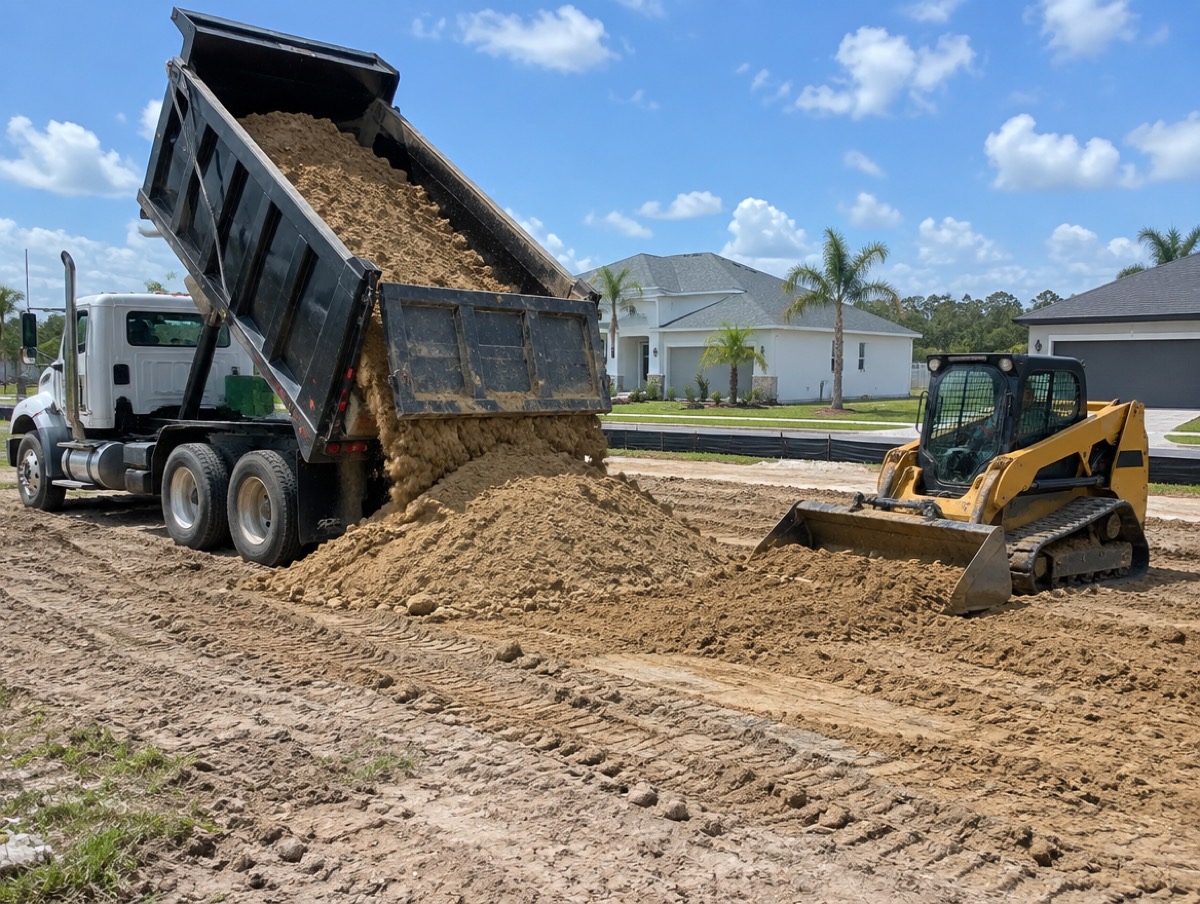
Fill is usually priced by the cubic yard or by the truckload, and a cubic yard is 27 cubic feet. The math is length times width times average depth, all in feet, divided by 27.
Say the house pad, plus the working shoulder the builder wants around it, measures 60 by 70 feet, and the plans call for raising it an average of 1.5 feet. That's 60 × 70 × 1.5 = 6,300 cubic feet, or about 233 cubic yards in place. Those are example numbers to show the arithmetic, not a figure for your lot.
Few lots are flat, so find the depth at several points and average them. If the pad has to finish 2 feet above the low corner and half a foot above the high corner, an average of about 1.25 feet is a fair start for a rough count. Then add:
- The driveway, if it's being raised too.
- Any area outside the pad that the drainage plan says to fill.
- Extra for compaction. Loose fill settles when it's compacted, so ask the supplier or your engineer how much to order over the in-place number.
Clear it right before it's filled
Fill over stumps, roots and a thick mulch layer is fill over material that will rot and settle. Ask the builder what has to come out of the pad area before fill goes down. Usually that means stumps pulled there rather than ground, even if the rest of the lot is mulched. The mulching vs. bulldozing guide explains the trade-off.
In Palm Bay, the grubbing permit for clearing underbrush by hand, roto-chopping or mulching doesn't authorize scraping, balancing or filling land (Palm Bay Code s. 175.015). Ask the city which permit covers the fill work on your lot.
Fill and the trees you keep
Raising the grade over a tree's roots can harm it, and in unincorporated Brevard it can also be a violation. The county code counts grade changes over the root system from excavation or filling as land clearing, along with soil compaction and root injury from machines (Brevard County Code s. 62-4338). If an oak is staying, the fill plan has to work around its roots. Settle that with the builder before the trucks arrive, not after.
Wetlands, flood maps and LOMR-F
If any part of the lot is wetland, filling it may need an Environmental Resource Permit from the St. Johns River Water Management District or FDEP, depending on the project (SJRWMD). In unincorporated Brevard, the county's natural resources office also wants wetland boundaries on a certified survey delineated within the last 5 years (Brevard NRMO).
Fill can change how the house sits on the flood map. Palm Bay's floodplain permit sheet describes FEMA's LOMR-F, a Letter of Map Revision based on fill, which removes the building from the Special Flood Hazard Area. The sheet says that with an approved LOMR-F, flood insurance is no longer mandatory for a federally insured mortgage, and that the city processes single-structure applications (Palm Bay floodplain permit requirements).
On bigger sites, disturbing 1 acre or more, or less as part of a larger common plan, brings in FDEP's stormwater Construction Generic Permit, with a pollution prevention plan and a notice filed before work starts (FDEP).
Before the trucks show up
If your builder is doing the site work, Brevard's code lets a certified building or residential contractor do clearing, grading and other site work only on the lot where its building is located. A certified general or underground utility contractor may do it on any construction project in the county (Brevard County Code ch. 22).
Then run through this list:
- Sunshine 811 notified at least two full business days ahead. Grading and moving earth count as digging (Sunshine 811).
- A place for trucks to dump and turn around without crossing a septic area, a neighbor's yard or a soft shoulder.
- Silt fence or other erosion control in place, if the permit calls for it.
- A Brevard County business tax receipt for whoever spreads the fill. The county lists filling and grading as a specialty trade exempt from county testing that still needs that receipt (Brevard County Code s. 22-477).
What to send for a fill quote
Send the survey, the drainage plan or at least the target pad elevation, the pad size and a few photos of the lot and the road in front of it. Say whether the lot is cleared yet. With real numbers, the crew you're matched with can price the yards instead of guessing, and you can compare quotes on the same count.
Questions people ask
How many cubic yards does a dump truck carry?
It depends on the truck. Ask the supplier how many yards each load carries and whether the price is per yard or per load, so two quotes can be compared.
Do I need a permit to bring in fill?
In Palm Bay, a site-specific building permit application includes a signed and sealed survey and drainage plan, and the grades come from those (Palm Bay Building Department). Wetlands, trees you're keeping and sites of an acre or more add their own rules. Ask the building department that issues your permit what applies.
Can fill take my house out of the flood zone?
Fill can support a FEMA LOMR-F, which removes the building from the Special Flood Hazard Area, and Palm Bay processes single-structure applications (Palm Bay). Whether a lot qualifies depends on the elevations, so ask your surveyor.
Why can't you just tell me how much fill I need?
Because the answer is in your survey and plans, not in a photo. Send them and the crew you're matched with can count it.
Sources
- City of Palm Bay Building Department, Floodplain Permit requirements
- City of Palm Bay Building Department, Master Plan Building Permit Program
- FEMA Flood Map Service Center
- Palm Bay Code of Ordinances, Chapter 175 (tree protection, land clearing and grubbing)
- Brevard County Code s. 62-4338, land clearing permit standards
- St. Johns River Water Management District, Do you need a permit?
- Brevard County Natural Resources Management, permitting review process
- FDEP, Construction Generic Permit (stormwater)
- Sunshine 811, frequently asked questions
- Brevard County Code s. 22-477, contractor definitions