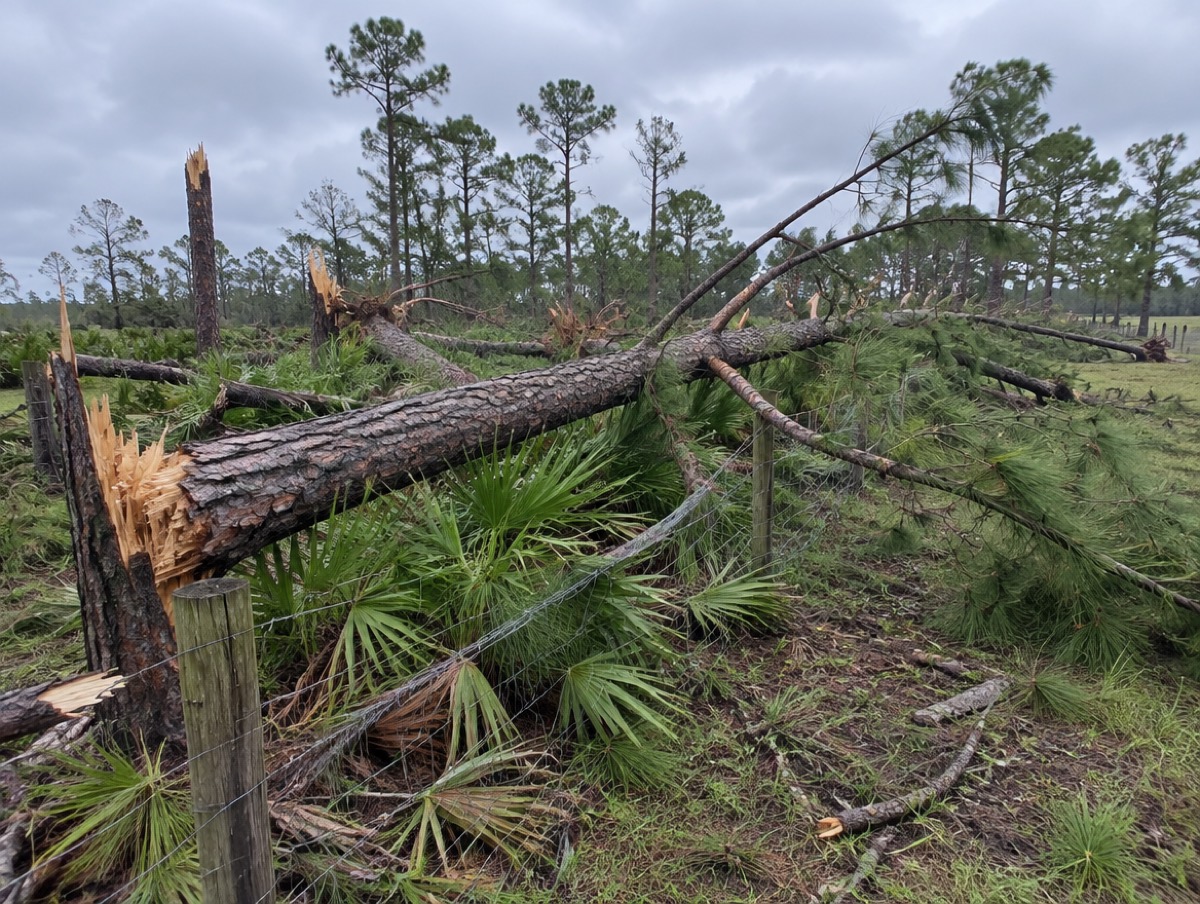
Safety before cleanup
Stay away from any tree or limb touching a power line, and report it to your electric utility. That's utility work and nobody else should touch it. Leaning trees, hung limbs and trunks pinned under other trunks hold a lot of tension and can move when cut. Leave those for a crew with the right machine.
Take photos of everything before anything moves. They help with the permit questions below, and with any insurance claim you decide to file.
Which trees come down
The Atlantic hurricane season runs June 1 to November 30, with the peak from August to October (NOAA Hurricane Research Division). In its Southeastern Coastal Plain ratings, UF/IFAS ranks laurel oak, water oak and sand pine lowest for wind resistance, slash pine medium-low, and live oak, sand live oak and cabbage palm highest. No tree is wind-proof (UF/IFAS, Wind and Trees).
Once the cleanup is done, look at which damaged or leaning trees should come out before the next season, and which sound live oaks and cabbage palms are worth keeping.
Permits after a storm
Codes in Brevard make room for storms, within limits. In the unincorporated county, the rules carve out an exemption for a dead or seriously damaged tree that's an immediate threat and has to come down in an emergency (Brevard County Code s. 62-4334). Before removing it, document the threat: photos of the tree and the damaged areas, rough measurements of height, spread and diameter, and the distance to the house or other targets if it fell (s. 62-4334(6)).
Palm Bay excepts trees posing an immediate threat once the city gives verbal authorization on site, and after a declared public emergency the city may suspend its tree rules, so check what it has announced (s. 175.014). In a hurricane or similar emergency, Melbourne's city manager can set the tree rules aside (Melbourne LDC s. 9.272). Titusville gives its City Manager the same power to waive requirements after a hurricane, flood or freeze (Titusville LDR s. 30-35).
None of that covers clearing the rest of the land while the crew is there. Downed and dangerous trees are one thing. The healthy woods behind them still fall under the normal rules.
Where the debris goes
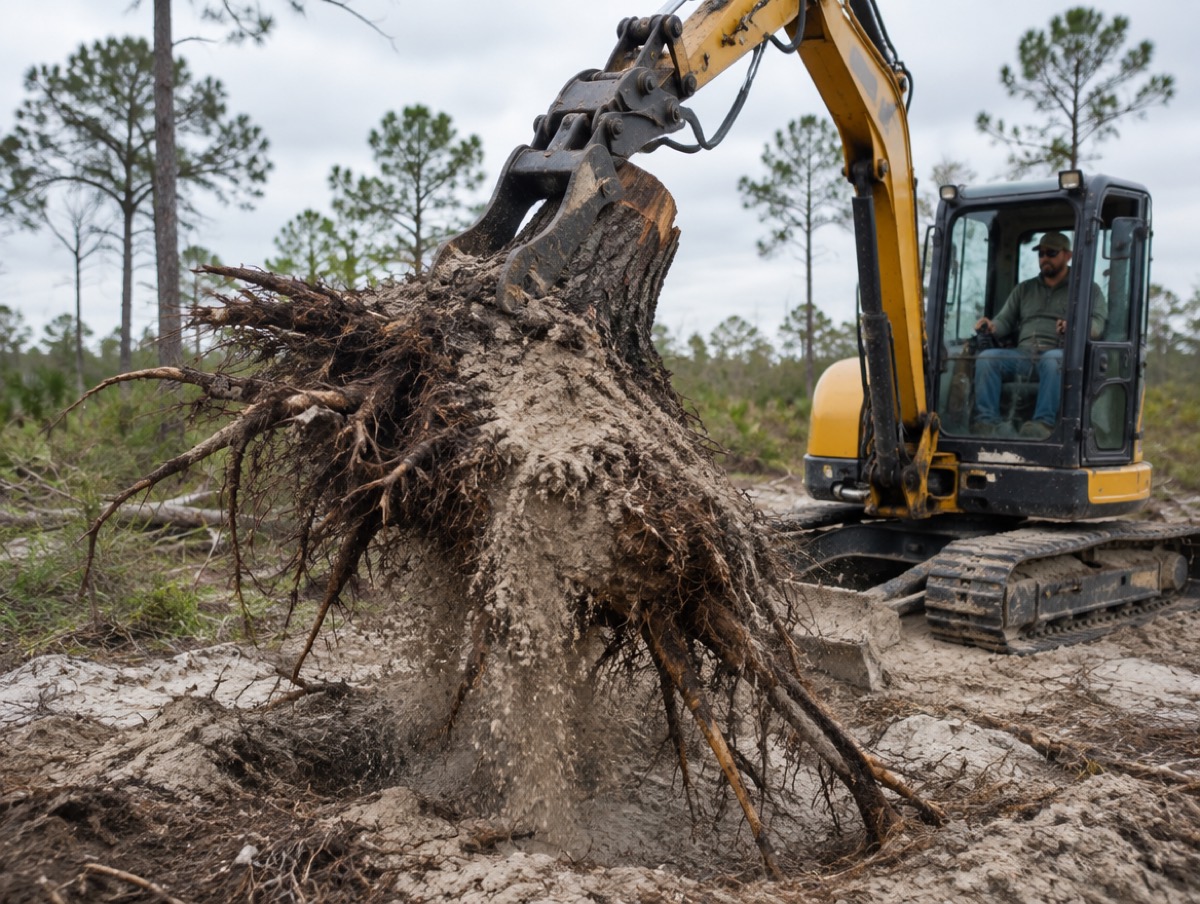
On acreage, the realistic choices are mulching the debris in place, hauling it off, or a mix of the two. For curbside pickup after a storm, check with Brevard County or your city for what they collect and when. A few acres of downed pines is usually more than a curb pile.
Burning is tightly limited. Land clearing pile burns need Florida Forest Service authorization, and residential debris piles have to sit 300 feet from neighbors' occupied buildings (FFS, Know the Law). Brevard's drought burn ban switches on when the index average reaches 500, but state-permitted burns, including FFS-authorized pile burns, are excluded from it (s. 50-1).
Neighbors, fences and who pays
UF/IFAS, citing a secondary legal source that doesn't bind courts, sums up the general Florida rule: if a live tree lands on the neighbor's property, the neighbor pays for their own damage. It adds that no Florida case law speaks directly to whether a landowner must remove dead or hazardous trees (UF/IFAS FE962). A 2025 bill that would have made owners liable for their fallen trees died in committee (SB 724, 2025). This is general information. For a real dispute, talk to your insurer or a lawyer.
Whether a policy covers debris removal is between you and your insurer. Nobody arranging the cleanup can promise that.
Questions for the crew
After a storm, getting in and out comes first. Ask:
- Has the utility cleared any lines on the property yet?
- Mulch in place, haul, or both?
- How will hung limbs and leaning trees be handled?
- Can the driveway and fence line be done first?
- Will stumps be left, ground or pulled?
Questions people ask
Do I need a permit to remove a storm-damaged tree?
Often not for a dead or seriously damaged tree that's an immediate threat, but document it first. The county lists photos, measurements and the distance to structures. Palm Bay wants on-site verbal authorization for an immediate threat. Rules differ by city; the permit guide has each one.
Who pays when a neighbor's tree falls on my land?
Under the general rule UF/IFAS summarizes from a secondary legal source, not binding on courts, if a live tree falls onto your property, you cover your own damages (UF/IFAS FE962). Florida has no case law directly on an owner's duty to remove dead or hazardous trees, and the 2025 Fallen Tree Act didn't pass. Ask your insurer or a lawyer about your situation.
Can storm debris be burned on my land?
Only under Florida Forest Service rules, and land clearing piles need FFS authorization with setbacks most homesites can't meet. Mulching or hauling is the usual choice.
How soon can a crew come after a hurricane?
Nobody can promise a date ahead of time. Calls pile up after a storm and crews work through them. Call or text with photos and the address as soon as it's safe, so your request is in line.
Should I cut the leaning trees myself?
Leave trees under tension, hung limbs and anything near a power line alone. Clearing small limbs off the driveway is one thing. A leaning pine is a job for a crew with a machine.
Last reviewed October 7, 2026. General information, not legal or professional advice. Check the linked sources for the current rules.
Sources
- NOAA Hurricane Research Division, hurricane FAQ
- UF/IFAS, Wind and Trees: Lessons Learned from Hurricanes (FR173)
- Brevard County Code s. 62-4334, exemptions
- Palm Bay Code of Ordinances, Chapter 175 (tree protection and land clearing)
- Melbourne LDC s. 9.272, tree protection
- Titusville LDR, Chapter 30 tree protection (s. 30-35 and s. 30-39)
- Florida Forest Service, Know the Law (land clearing burns)
- Brevard County Code s. 50-1, open burning
- UF/IFAS, Handbook of Florida Fence and Property Law (FE962)
- Florida Senate, SB 724 (2025), Property Owner Liability